psst… want a peek?
less is more
Simple means minimal: few lines, basic shapes, clear outlines. These prompts strip a subject down to its essentials — perfect for warm-ups, icons, and relaxed sketching.
Easy and simple answer different questions. Easy describes skill level: how much drawing experience, time, perspective, anatomy, or shading a prompt is likely to require. Simple describes composition: how many visual elements appear, how cleanly they are arranged, and whether the subject can be understood through a small number of lines and shapes. One prompt can be both, but the words are not interchangeable.
Consider a sunset over mountains. The individual shapes are beginner-friendly, so the idea may be Easy. Yet the picture can include several mountain layers, a sun, sky bands, a horizon, water, and reflections. Those extra relationships mean the composition is not especially Simple. In contrast, a continuous-line drawing of one hand has very few elements, but placing five fingers with convincing proportions can still be difficult.
Use Easy when you want a forgiving skill challenge. Use Simple when you want a visually quiet page with one clear focal point. If you want both, choose a familiar object, remove the background, and limit yourself to the details that make the object recognizable.
A smaller composition gives a practice session a clear boundary. You still make meaningful choices, but there are fewer competing problems to solve at once.
A prompt with one subject and little or no background removes choices about staging, scale, lighting, and supporting objects. You can spend that attention on the line in front of you instead of planning an entire scene before the pencil moves.
A limited composition has a visible stopping point. Once the main contour and its few identifying details are in place, the drawing can be complete. That makes simple prompts practical for a sketchbook break, a class warm-up, or one page of daily practice.
Clean shapes make every stroke easy to see. Repeating an oval, curve, or straight edge helps you notice hesitant marks and practice drawing with a steadier motion. The goal is not flawless line art; it is learning to place a line with clearer intention.
Keep each sketch small and complete the main outline before adding texture or color. These prompts are starting points, so stopping after the suggested marks is a valid finished study.
Draw the outer silhouette first, then use one center line to place the three smaller veins.
Use an oval for the rim, two nearly parallel sides, and one open loop for the handle.
Connect three or four soft arcs and place a single teardrop shape beneath them.
Keep the body and tail separate until their proportions feel balanced, then join the outlines.
Start with a wide rectangle and let one narrow ribbon break the otherwise plain silhouette.
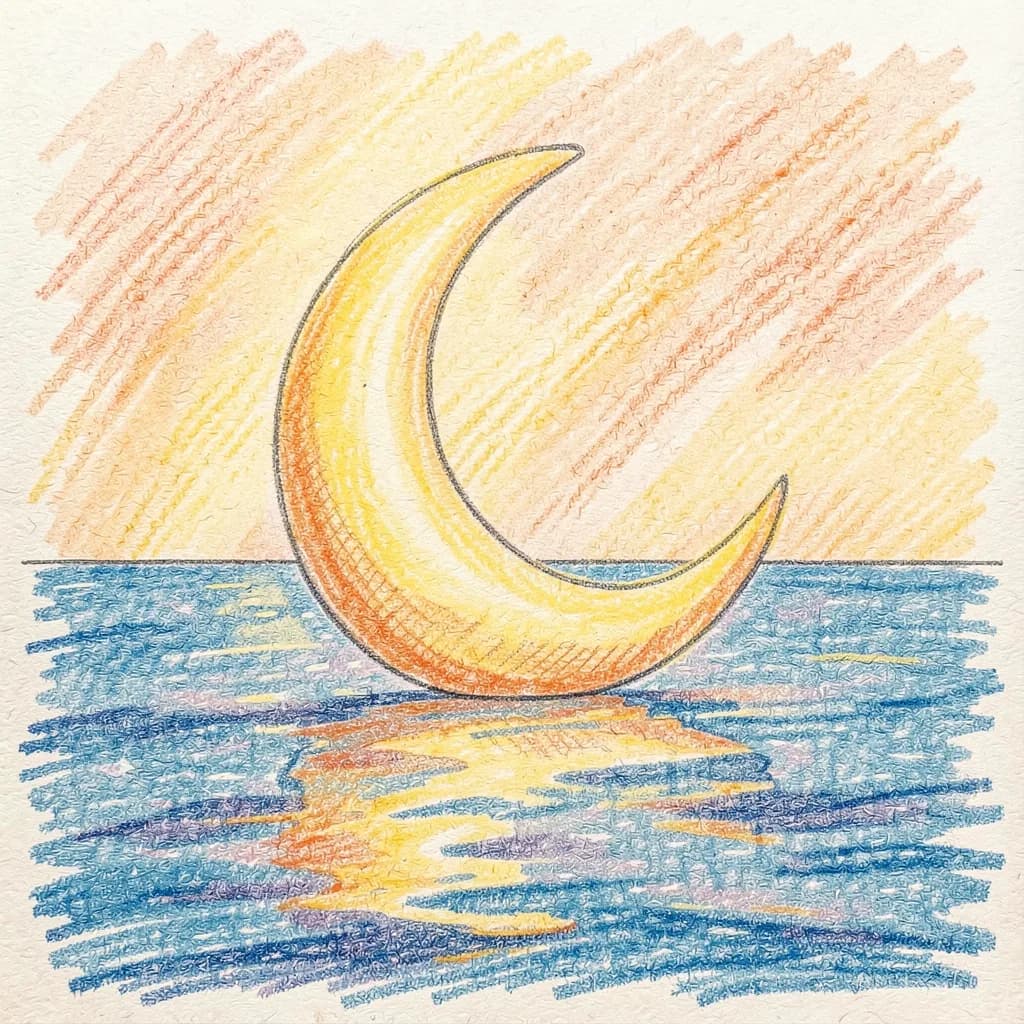
Leave generous blank space and use the waterline to anchor the moon without adding a full landscape.
Combine a short cylinder, one tall rounded stem, and no more than two side arms.
Use three straight edges for the main shape and one inner fold line to show its construction.
Divide one oval down the center and place three dots on each side for an easy symmetry exercise.
Reduce the lamp to a base, two angled arm segments, and a cone aimed at one empty spot.
not quite it?
Try the full generator with every category and difficulty, or explore easy, simple, kids, and random ideas.